Glas Fían
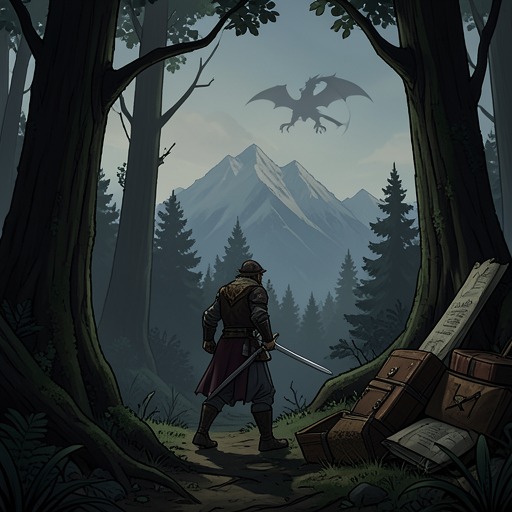
The Ballad of the Last DragonGlas Fían—now known as The Veridian Wilds—is both a vanished name preserved by an old map and a dangerous living wilderness encountered by the expedition. Its significance lies in the way it joins historical uncertainty to immediate physical threat: the travelers must reconstruct a route through a place whose former name has been forgotten, then survive the forest’s monstrous inhabitants before they can reach the dragon’s mountain refuge.
Names, Map, and Route
The expedition’s knowledge of Glas Fían comes through translated directions that Aeron cannot understand on his own. The map identifies the region by its older name, while the surrounding valley, Bealucwelm, has also acquired a newer human name that the narrator cannot remember. This layered naming makes the landscape a record of cultural change as much as a stretch of wilderness; the route survives, but the language that once organized it has partly disappeared.
The instructions impose a precise but arduous passage through Glas Fían. The travelers are to keep the sun on their left shoulder until midday for three days, leave the road, cross the river, and continue to the base of a mountain pass. They are then directed not to use the pass itself, but to climb the western peak to a cave where the dragon awaits. The forest therefore functions as the first major geographical threshold in the expedition’s approach to the dragon: it is not merely crossed, but interpreted through a sequence of remembered directions and difficult deviations from ordinary roads.
Wilderness and Threat
Before the attack, Glas Fían belongs to the realm of stories about forest beasts—oversized creatures found deep in woods where human settlement has never taken permanent hold. The narrator has repeated such tales professionally, but the forest forces a sharp distinction between imagined material and embodied danger. What had once been suitable subject matter for an enthralling story becomes an encounter whose reality cannot be controlled by language.
That reversal culminates when a swarm of giant beetles, each the size of a wild hound, surrounds the party. Their shiny black shells catch the sunlight, while their high-pitched buzzing overwhelms the senses, vibrating through the narrator’s teeth and ear canals and prickling against the skin. The attack gives Glas Fían a distinctly hostile physical presence: the forest is not silent scenery around the quest, but an environment capable of producing coordinated, overwhelming violence.
The Beetle Attack
The attack reveals the group’s differing forms of competence. Neith immediately yanks the narrator to the ground and pushes her behind a hollow log, then places herself between the vulnerable traveler and the swarm. Armed with a sword and dagger, she cuts down a beetle flying dangerously close, wielding her longsword with expert finesse and without any apparent loss of breath.
The others fight in the midday sun. Cadoc uses dual daggers with extraordinary speed despite their limited reach, moving with the grace of a choreographed performance before switching to his bow. He shoots a beetle that lands hard beside the narrator, turning precise marksmanship into another form of protection. The combat transforms the expedition’s map-reading journey into a test of the party’s practical abilities, while the narrator remains positioned as both witness and endangered participant.
Fever, Camp, and Narrative Meaning
The beetles’ danger continues after the immediate fighting because their venom leaves Neith facing a night of fever dreams and disorientation. Cadoc refuses to risk her falling from her horse and the party makes camp while the sun is still high. Neith withdraws into her tent, with Cadoc following to care for her, while Aeron watches their departure with a lingering, longing stare. The forest encounter consequently exposes not only physical vulnerability but also the emotional dependencies within the group.
At dusk, the camp has narrowed to Jaromir, Aeron, and the narrator around the fire; Cadoc briefly emerges to collect food for himself and Neith before returning behind the tent flaps. The narrator does not reach for her lute, allowing the silence to settle after the violence. Glas Fían thus marks a movement from artistic distance to lived experience: the beasts she might once have killed to describe convincingly have shown her that stories are safer in the mind than in the world. The forest’s decisive narrative function is to make the expedition’s legendary destination feel materially real long before the travelers reach the dragon’s cave.